

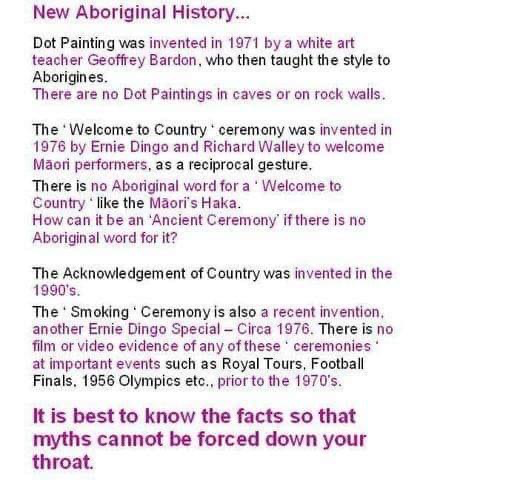
I came across this image on social media and decided to research whether the claims in it hold up. I was genuinely surprised by what I found. Below I break it down point by point, drawing on documented sources.
Dot Painting
Claim: Dot painting was invented in 1971.
This is partially true, but the framing is misleading.
Dot painting in the context of Aboriginal culture is not new. Traditional dot and pattern work has existed for thousands of years in ceremonial contexts including body painting, ground designs, and rock art. It was never a secret or an invention.
What did happen in 1971 is that the modern canvas-based dot painting style was developed by the Papunya Tula artist group in the Northern Territory. Geoffrey Bardon, a schoolteacher working in Papunya, encouraged local Aboriginal artists to paint their traditional stories and symbols using acrylic paints and canvas. This led to the distinctive style that became internationally recognised and commercially successful.
So the art form itself is ancient. The medium of acrylic on canvas dates to 1971. That distinction matters.
Key references:
- Papunya: A Place Made After the Story by Geoffrey Bardon and James Bardon
- Australian Institute of Aboriginal and Torres Strait Islander Studies (AIATSIS): aiatsis.gov.au
- National Gallery of Australia: nga.gov.au
- Papunya Tula Artists: papunyatula.com.au
The “Welcome to Country” Ceremony
Claim: Ernie Dingo invented the “Welcome to Country” ceremony in 1976.
This claim is false on two counts.
First, the Welcome to Country is an ancient Aboriginal practice, not an invention. The act of traditional custodians formally welcoming visitors to their land has been part of Aboriginal culture for thousands of years, with distinct forms across different nations.
Second, the date of 1976 is also incorrect. The credit for bringing Welcome to Country into formal contemporary public use goes to Noongar man Richard Walley, who developed a modern version of the ceremony in the late 1970s and early 1980s for use at public events. Ernie Dingo collaborated with Walley and helped popularise it, particularly around the time of the Australian Bicentennial in 1988, which gave the ceremony significant national exposure.
Dingo’s contribution was real and meaningful. But he promoted an ancient cultural practice, he did not create one.
Key references:
- Reconciliation Australia: reconciliation.org.au
- AIATSIS cultural protocols resources
- Welcome to Country: A Travel Guide to Indigenous Australia by Marcia Langton
There Is No Single Aboriginal Word for “Welcome to Country”
Claim: There is no Aboriginal word for “Welcome to Country.”
This is accurate, though it requires context to avoid being misleading.
Australia has over 250 distinct Aboriginal language groups, each with their own vocabulary, traditions, and ceremonial practices. There is no single pan-Aboriginal language, so there is no single word or phrase that translates to “Welcome to Country” across all groups.
Individual nations do have their own words and protocols for welcoming visitors in their own languages. The term “Welcome to Country” is an English-language descriptor that emerged to make the practice accessible and understandable in a contemporary, multicultural context. Its absence as a single universal Aboriginal term reflects linguistic diversity, not cultural inauthenticity.
Key references:
- AIATSIS language and culture resources
- Reconciliation Australia
- Welcome to Country by Marcia Langton
The “Acknowledgement of Country” Was Formalised in the 1990s
Claim: The Acknowledgement of Country was invented in the 1990s.
This is accurate.
The Acknowledgement of Country as a formal contemporary practice was developed in the 1990s as part of broader reconciliation efforts. It was designed as a way for non-Indigenous Australians and organisations to show respect for traditional custodians when a full Welcome to Country ceremony was not being performed.
It was progressively adopted by government bodies, educational institutions, and public organisations during this period. The practice draws on the principles behind the ancient Welcome to Country but is itself a modern, formalised convention.
Key references:
- Reconciliation Australia: reconciliation.org.au
- Australian Government cultural protocol guidelines
- AIATSIS
The Smoking Ceremony
Claim: The smoking ceremony was also invented by Ernie Dingo.
This is false.
The smoking ceremony is one of the oldest documented Aboriginal rituals in Australia. It involves burning native plants to produce cleansing smoke, used for healing, spiritual protection, and purification. Different plant species are used depending on the region and the specific purpose of the ceremony. The practice varies across nations and has been passed down through thousands of generations of Aboriginal Elders.
Ernie Dingo has been a prominent advocate for Aboriginal cultural recognition in modern Australian society, but he had no role in creating the smoking ceremony.
Key references:
- AIATSIS cultural heritage resources
- Australian Aboriginal Studies journal
- Aboriginal community Elders and cultural custodians (primary source)
Conclusion
Looking at the original image that prompted this research, the picture is mixed. Some of the claims it makes are true in a narrow sense, some are flatly false, and some are misleading without context.
The dot painting canvas style does date to 1971. The Acknowledgement of Country was formalised in the 1990s. These things are documented.
But the framing that Aboriginal cultural practices like Welcome to Country and the smoking ceremony are modern inventions or political constructs does not hold up. These are ancient practices. The contemporary versions have been adapted for modern public life, but the cultural roots are real and deep.
Getting this right matters. Misrepresenting these practices, in either direction, does not serve anyone.
